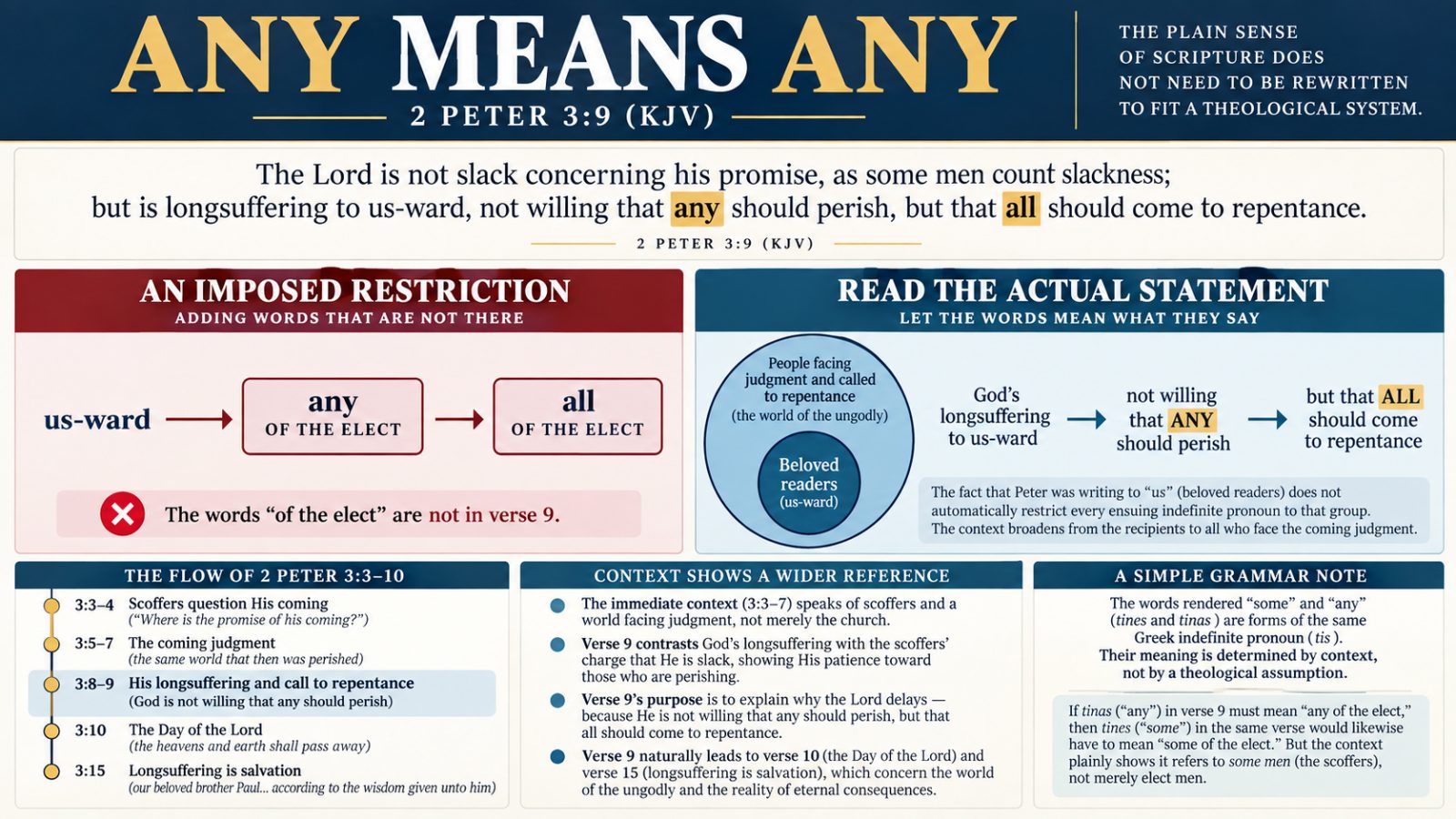
The plain meaning of Scripture should govern our theology—not the other way around.
FOUNDATIONAL TEXT — 2 PETER 3:9 (KJV)
"The Lord is not slack concerning his promise, as some men count slackness; but is longsuffering to us-ward, not willing that any should perish, but that all should come to repentance."
INTRODUCTION: WHEN THEOLOGY BECOMES MORE COMPLICATED THAN SCRIPTURE
There is something profoundly troubling about an approach to biblical interpretation that takes one of Scripture's clearest declarations of God's longsuffering and turns it into an elaborate exercise in theological restriction.
Peter declares that God is not willing that ANY should perish, but that ALL should come to repentance.
Yet we are sometimes told that any cannot refer to any person and all cannot refer to mankind generally. Instead, we must understand these words as referring exclusively to a particular, predetermined group of individuals: the elect.
To support this interpretation, elaborate linguistic explanations, contextual arguments, theological distinctions, and carefully constructed diagrams are employed to demonstrate why the passage apparently cannot communicate what an ordinary reader would naturally understand it to mean.
There is nothing wrong with serious biblical scholarship. We ought to examine grammar, historical background, original languages, and literary context. Indeed, careful exposition is essential to rightly dividing the Word of truth.
But scholarship must serve Scripture. It must never become a mechanism by which we explain away Scripture.
The question is not whether we can construct an interpretation that accommodates a particular theological system. The question is whether Peter himself actually teaches that interpretation.
Those are two very different questions.
- THE GREEK DOES NOT SAY "ANY OF THE ELECT"
Consider the actual wording of 2 Peter 3:9.
Three Greek expressions deserve particular attention:
KJV Expression
Greek
Meaning
Not willing
βουλόμενος (boulomenos)
Willing, wishing, desiring
Any
τινας (tinas)
Any persons, anyone
All
πάντας (pantas)
All, everyone
Neither tinas nor pantas contains an explicit qualification identifying its referents as the elect.
Peter does not write that God is unwilling for any of the elect to perish. Nor does he write that God desires all of the elect to come to repentance.
Those qualifications must be supplied through interpretation. They are not present in the Greek text itself.
Does this automatically settle every contextual question? Certainly not. Words such as any and all can have a restricted reference when the context establishes one.
For example, the statement "Every student passed the examination" might naturally refer to every student in a particular classroom. The surrounding context establishes the scope.
But that is precisely the issue here.
A proposed restriction must be demonstrated from the passage itself, not merely imported because a theological framework requires it.
The Greek does not magically change any into the elect. The burden rests upon the interpreter proposing that restriction to demonstrate that Peter intended it.
- DOES "US-WARD" RESTRICT THE MEANING OF "ANY" AND "ALL"?
The principal argument for the restrictive interpretation concerns the preceding phrase:
"But is longsuffering to us-ward."
The argument proceeds as follows: Peter is writing to believers. Therefore, the expressions any and all must refer exclusively to believers—or, by extension, to the complete company of God's elect, including those who have not yet believed.
At first glance, this interpretation may appear contextually persuasive. It takes the identity of Peter's original audience seriously, which is a legitimate interpretive concern.
However, the conclusion does not necessarily follow from the premise.
The recipients of a statement do not automatically determine the complete extent of every subsequent statement.
Consider this illustration:
"Dear brethren, God has been merciful to us because He desires all men to repent."
Who receives the letter? Believers.
Who is directly addressed? Believers.
Does this require the expression all men to mean believers exclusively?
Obviously not.
Peter can address Christians concerning God's longsuffering while simultaneously explaining that His longsuffering reflects His desire that sinners come to repentance.
The audience receiving an explanation and the people encompassed by that explanation are not necessarily identical.
Notice also that the KJV's "us-ward" reflects the Greek expression eis hēmas, whereas several other Greek editions contain eis hymas, meaning "toward you." Neither reading inserts the expression "of the elect" after any or all.
The restrictive interpretation must therefore demonstrate more than the fact that Peter addressed Christians. It must establish that Peter intended the following indefinite expressions to encompass exclusively elect individuals.
That additional step remains an interpretive conclusion—not a grammatical necessity.
- PETER USES THE SAME GREEK INDEFINITE PRONOUN EARLIER IN THE VERSE
There is another grammatical observation worthy of attention.
At the beginning of verse 9, Peter writes:
"The Lord is not slack concerning his promise, as some men count slackness..."
The word translated some men is tines (τινες).
Later in the same verse, he writes:
"Not willing that any should perish..."
The word translated any is tinas (τινας).
These are different grammatical forms of the same Greek indefinite pronoun, tis.
This does not mean both expressions must have an identical referent. Quite the opposite: their respective references must be established contextually.
The some men of verse 9 naturally relates to the preceding discussion concerning those questioning God's promised coming. Peter has already introduced scoffers in verses 3–4.
If Peter's Christian audience automatically restricted every indefinite expression in the verse, the opening reference to some men would also have to be understood through that same restriction.
But we do not determine the reference of an indefinite pronoun merely by identifying the audience of the letter. We examine what Peter is actually discussing.
We cannot insist that one occurrence is contextually flexible while treating another as grammatically restricted merely because that restriction supports our theology.
Context determines the reference of a word. A theological assumption must not be allowed to determine the context.
- THE IMMEDIATE CONTEXT CONCERNS GOD'S IMPENDING JUDGMENT UPON THE UNGODLY
We are frequently told that 2 Peter 3:9 must be understood in context.
Agreed!
So let us actually examine that context.
Peter opens the chapter by discussing scoffers who question the promised return of Christ.
In verse 4, they ask:
"Where is the promise of his coming?"
Peter then reminds his readers of God's former judgment through the Flood.
In verse 7, he explains that the present heavens and earth are:
"Reserved unto fire against the day of judgment and perdition of ungodly men."
Notice the subject: the coming judgment of ungodly men.
Verse 8 reminds believers that God's relationship to time is not the same as ours.
Verse 9 explains His longsuffering.
Verse 10 declares that the day of the Lord will nevertheless come.
THE NATURAL PROGRESSION OF 2 PETER 3
VERSES 3–4: THE QUESTION
Why has Christ not returned?
↓
VERSES 5–7: THE WARNING
God has judged the ungodly before and will do so again.
↓
VERSES 8–9: THE EXPLANATION
His apparent delay reflects His longsuffering.
↓
VERSE 10: THE CERTAINTY
The day of the Lord will come.
↓
VERSE 15: THE APPLICATION
"And account that the longsuffering of our Lord is salvation."
The passage explains why divine judgment has not yet arrived.
Peter's explanation is God's longsuffering. He is not willing that any should perish, but that all should come to repentance.
Reading this declaration as an expression of God's desire that sinners repent does not abandon the context. It fits naturally within it.
The restrictive interpretation, however, introduces an additional category that Peter does not explicitly identify in his immediate explanation: the yet-unconverted elect.
It is legitimate to discuss election wherever Scripture addresses the subject. But why should we assume that Peter is silently referring exclusively to that category when his explicitly stated subjects are judgment, longsuffering, perishing, and repentance?
- PETER HAS ALREADY CONNECTED GOD'S LONGSUFFERING WITH NOAH'S DAY
We do not have to leave Peter's writings to discover how he uses the concept of divine longsuffering.
Consider 1 Peter 3:20:
"Which sometime were disobedient, when once the longsuffering of God waited in the days of Noah, while the ark was a preparing, wherein few, that is, eight souls were saved by water."
God's longsuffering is associated with the period preceding judgment.
The context specifically identifies disobedient people and reminds us that only eight souls were preserved in the ark.
Peter brings this same historical judgment into his argument in 2 Peter 3.
The parallel is significant.
IN NOAH'S DAY: God's longsuffering preceded the judgment of the Flood.
IN 2 PETER 3: God's longsuffering precedes the coming day of judgment.
His patience must not be mistaken for indifference toward sin or uncertainty concerning His promises.
This parallel does not independently settle every theological question concerning election. It does demonstrate, however, that Peter understands divine longsuffering in the setting of a world facing judgment.
Why should we insist that when Peter reaches 2 Peter 3:9, God's longsuffering must suddenly be restricted exclusively to an otherwise unidentified category of elect individuals?
Peter has provided no explicit restriction of that kind.
- GOD'S DESIRE FOR ALL TO REPENT DOES NOT TEACH UNIVERSAL SALVATION
Another frequent objection is that if any refers to anyone and all encompasses mankind, the passage must necessarily teach universal salvation.
But this confuses two entirely different propositions.
Peter tells us what God desires. He does not declare that every human being will ultimately repent.
There is a tremendous difference between saying that God does not desire sinners to perish and saying that no sinner will ever perish.
Peter has already affirmed the coming judgment of ungodly men in verse 7.
The supposed contradiction disappears when both statements are allowed to stand.
God genuinely desires repentance.
God genuinely warns of judgment.
Sinners are genuinely responsible for their response to His Word.
Consider Ezekiel 33:11:
"Say unto them, As I live, saith the Lord GOD, I have no pleasure in the death of the wicked; but that the wicked turn from his way and live: turn ye, turn ye from your evil ways; for why will ye die, O house of Israel?"
God explicitly expresses His disposition toward the wicked while simultaneously warning them of the consequences of refusing to turn from their wickedness.
We are not compelled to conclude that everyone will repent simply because God expresses His desire that sinners turn and live.
Nor are we compelled to conclude that His desire cannot be genuine because some will refuse.
God's stated desire for repentance does not logically establish universal salvation.
Consequently, universalism cannot legitimately be used as a reason for automatically restricting the words of 2 Peter 3:9 to the elect.
- SCRIPTURE INTERPRETS SCRIPTURE: GOD'S CONCERN FOR ALL MANKIND
Second Peter 3:9 is not an isolated declaration.
Throughout Scripture, God repeatedly expresses His saving provision, His gracious invitation, and His call for mankind to repent.
Consider the following passages.
1 Timothy 2:4
"Who will have all men to be saved, and to come unto the knowledge of the truth."
1 Timothy 2:6
"Who gave himself a ransom for all, to be testified in due time."
Acts 17:30
"And the times of this ignorance God winked at; but now commandeth all men every where to repent:"
1 John 2:2
"And he is the propitiation for our sins: and not for ours only, but also for the sins of the whole world."
Romans 2:4
"Or despisest thou the riches of his goodness and forbearance and longsuffering; not knowing that the goodness of God leadeth thee to repentance?"
These passages establish a consistent biblical pattern.
God's saving disposition is not presented as indifference toward the lost.
His goodness, forbearance, and longsuffering are meaningful expressions of His gracious character.
Romans 2:4 is particularly relevant. Paul identifies God's goodness and longsuffering as leading people toward repentance, while the surrounding passage warns those who remain hardened against Him.
That is precisely the combination discovered in 2 Peter 3.
JUDGMENT IS CERTAIN.
GOD IS LONGSUFFERING.
REPENTANCE IS NECESSARY.
These truths are neither contradictory nor mutually exclusive. We should permit them to stand together in their natural biblical meaning.
- EVEN JOHN CALVIN DID NOT NEED TO CHANGE "ANY" INTO "THE ELECT"
An interesting historical observation deserves consideration.
In his commentary on 2 Peter 3:9, John Calvin explicitly describes God's disposition in terms of His love toward mankind.
He writes:
"So wonderful is his love towards mankind..."
Calvin goes on to explain God's saving invitation as presented through the Gospel, while separately retaining his own understanding of divine election.
He distinguishes what he understands to be God's revealed will in the Gospel from His hidden decree.
We need not agree with Calvin's entire doctrine of election to recognize the significance of this observation.
Even Calvin did not believe that acknowledging the universal language of this passage required him simply to replace any and all with the elect.
One can examine the Greek, consider the context, recognize the broader theological questions, and still acknowledge the universal expression of God's mercy within the passage.
Indeed, recognizing what the words actually say is not an indication of intellectual deficiency.
Historical reference: John Calvin, Commentary on 2 Peter 3:9–13, Christian Classics Ethereal Library.
https://www.ccel.org/ccel/calvin/calcom45.vii.iv.iii.html
- INTELLECTUAL SOPHISTICATION IS NOT THE SAME AS EXEGETICAL ACCURACY
This is where the larger issue becomes particularly important.
There is a tendency in certain theological discussions to equate interpretive complexity with interpretive superiority.
An explanation becomes increasingly technical. Greek terminology is introduced. The immediate audience is identified. Additional theological categories are constructed. Carefully designed diagrams demonstrate why a straightforward understanding of the text supposedly cannot be sustained.
Yet none of these things, by themselves, establishes the correctness of the conclusion.
A diagram can illustrate an argument. It cannot establish an argument that the underlying text does not support.
Greek terminology can clarify Scripture. It cannot legitimately insert words Scripture does not contain.
An appeal to context must actually demonstrate the proposed interpretation rather than merely establish that the interpretation is compatible with a particular doctrinal framework.
The issue is not whether an interpretation sounds scholarly.
The issue is whether the apostle actually intended what the interpreter claims.
If an interpretation requires us to introduce a theological category that is not explicitly stated, then treat that imported category as though it were the controlling meaning of the verse, we should be especially careful before accusing those who question that interpretation of failing to understand Scripture.
This is not an argument against theological education.
It is an argument for sound theological education.
The responsibility of a biblical expositor is to uncover the meaning of the inspired text, not to demonstrate how ingeniously that text can be made to fit a predetermined system.
The ordinary Christian does not need a doctorate to understand that God has revealed Himself as longsuffering and merciful toward sinners.
- PETER'S OWN CONCLUSION REVEALS THE EMPHASIS OF THE PASSAGE
Return to 2 Peter 3:15:
"And account that the longsuffering of our Lord is salvation..."
Peter does not conclude his argument by directing attention to an invisible list of predetermined individuals.
He directs attention to the saving significance of God's longsuffering.
That is the theological emphasis he wants his readers to remember.
The Lord has not forgotten His promise.
He has not lost control of history.
He is not indifferent toward wickedness.
Judgment is coming.
But His longsuffering is salvation.
It is time in which the Gospel can be proclaimed, sinners can repent, and the mercy of God can be received.
Rather than using the passage to narrow our understanding of God's concern for sinners without adequate textual justification, we should allow it to enlarge our appreciation of His mercy and deepen our urgency to proclaim the Gospel.
CONCLUSION: LET THE WORD OF GOD SPEAK
There is nothing objectionable about carefully examining the original languages. There is nothing objectionable about studying historical context. There is nothing objectionable about theological precision.
What should concern us is treating a theological inference as though it were a grammatical necessity, then dismissing those who question that inference as intellectually unsophisticated.
Peter wrote:
"Not willing that any should perish, but that all should come to repentance."
He did not add of the elect.
He did not require his readers to discover an unstated classification before understanding the plain force of his declaration.
And he certainly did not teach that the more complicated our explanation becomes, the more faithful it necessarily is to the text.
We should never confuse theological complexity with biblical fidelity.
The measure of faithful exposition is not how much intellectual machinery we can build around a passage, but how accurately we communicate what God has actually said.
God is longsuffering.
He does not desire that sinners perish.
He calls men to repentance.
And every additional day before judgment is another reminder that His patience should never be mistaken for permission to remain in unbelief.
There is nothing intellectually embarrassing about believing these truths.
What ought to concern us is becoming so committed to defending a theological system that we can no longer allow Scripture to speak for itself.
ANY MEANS ANY. ALL MEANS ALL.
And if we wish to restrict either expression, the burden is upon us to demonstrate that Peter himself intended the restriction—not merely that our theological system requires it.
RIGHTLY DIVIDING — Biblical Apologetics & Theological Examination