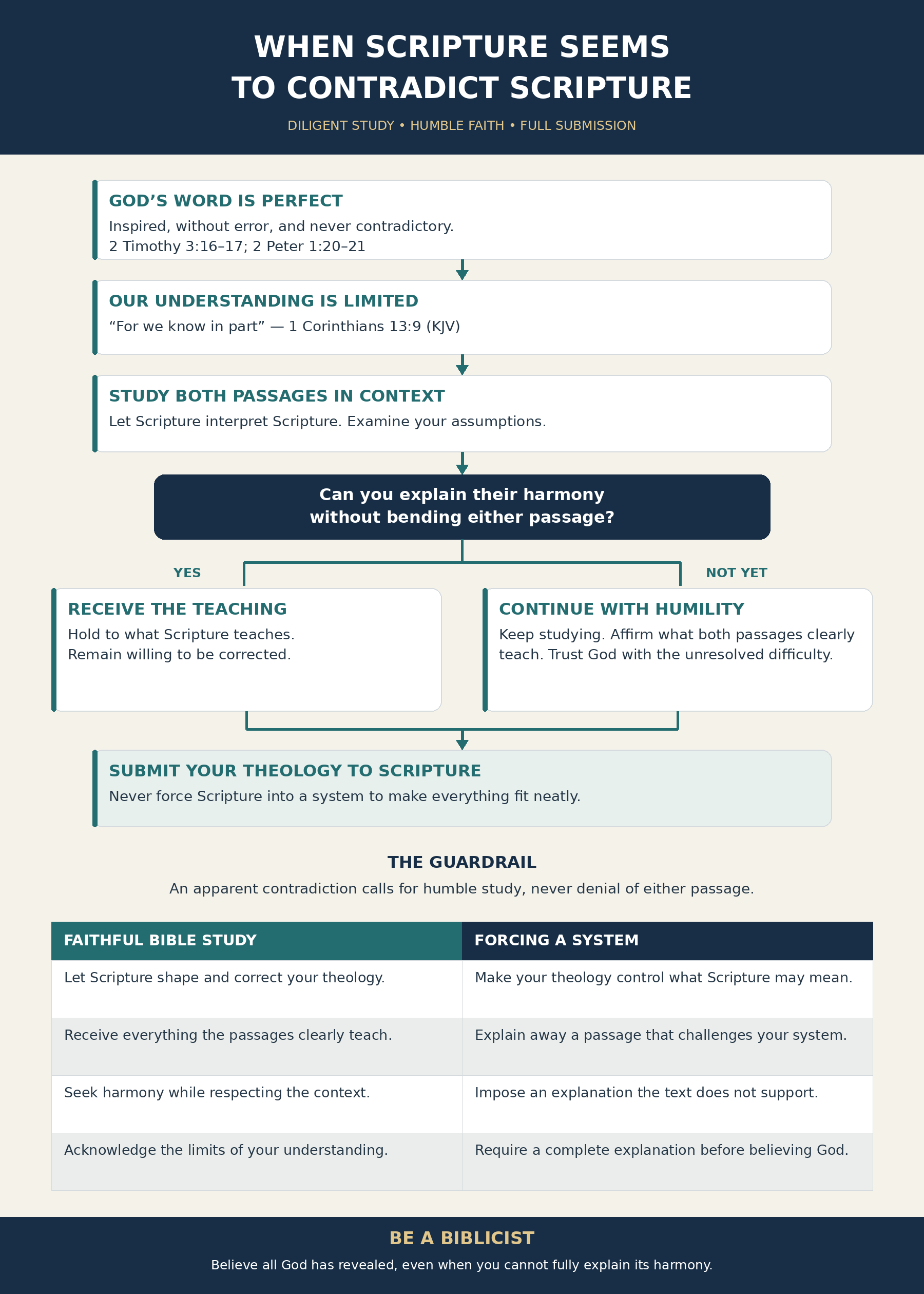
After looking up, reading, and studying the key Scripture references in their context, seek to understand how they fit together, allowing Scripture to interpret Scripture. Because the Word of God is inspired by God (2 Timothy 3:16–17; 2 Peter 1:20–21), and because God cannot err, His Word cannot err or contradict itself.
However, the perfection of Scripture does not mean that our understanding of Scripture is perfect. Even after diligent study, we may encounter passages whose harmony we cannot fully explain. The apparent contradiction lies in our limited understanding, never in God’s Word.
When this happens, continue studying, examine your assumptions, and remain willing to correct your interpretation. Where both passages clearly teach something, receive both by faith, trusting that God understands perfectly what we understand only partially. Faith does not excuse careless study; neither does diligent study guarantee that we can resolve every difficulty. “For we know in part” (1 Corinthians 13:9).
Beware of forcing Scripture into a theological system merely to make everything fit neatly together. The desire for a complete explanation can tempt us to explain away one passage to protect our interpretation of another, impose meanings the text does not support, or make our theology the judge of Scripture. A system’s internal consistency does not establish its biblical faithfulness.
Our goal is to be biblicists: fully submitted to the whole counsel of God, willing to let Scripture correct our theology rather than bending Scripture to preserve it. Hold firmly to what God has clearly revealed, humbly acknowledge what you cannot yet reconcile, and trust Him with what remains beyond your understanding. Scripture is perfectly harmonious, even when our explanation of it is incomplete.